Short answer: the main AWS alternatives are Microsoft Azure and Google Cloud if you need a full hyperscale platform, Oracle Cloud (OCI) if data transfer costs or Oracle databases matter, DigitalOcean, Akamai Cloud (Linode) and Hetzner if you want simple, predictable pricing for websites and apps, OVHcloud for European hosting with unmetered bandwidth, and Cloudflare for storage and edge apps with no egress fees. The right choice depends on the job, not on which provider is “best”.
Amazon Web Services is still the largest cloud provider in the world. But “largest” does not mean “right for everyone”. Many small businesses, SaaS founders and agencies run on AWS because it was the default choice, then find the bill hard to predict, the console hard to learn and the data transfer charges hard to explain.
This guide compares the real alternatives to AWS in plain English: who the big competitors are, what each one is good at, where each one catches people out, and how to decide whether moving is worth it at all. Every price and figure below was checked against the provider’s own pages or a named research source in November 2026.
Key takeaways
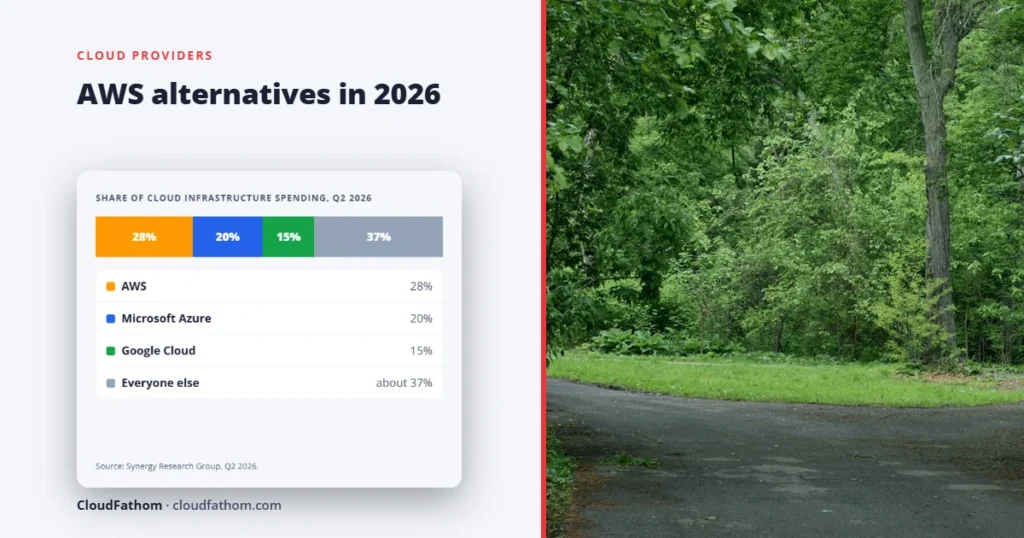
- AWS still leads with about 28% of worldwide cloud infrastructure spending, ahead of Microsoft (20%) and Google (15%), according to Synergy Research Group’s Q2 2026 figures.
- For a like-for-like replacement, Azure and Google Cloud are the only providers with a similar range of services worldwide.
- For lower, simpler bills, DigitalOcean, Akamai Cloud and Hetzner include monthly bandwidth with their servers and charge far less for extra transfer than AWS.
- Data transfer (egress) is often the deciding cost. AWS charges about $0.09 per GB after the first 100 GB a month; Oracle includes the first 10 TB a month free.
- Leaving AWS is cheaper than it used to be. AWS, Google and Microsoft all waive data transfer fees for customers who move out, and the EU Data Act bans switching charges from 12 January 2027.
- Moving is not always the answer. Fixing waste on AWS first is often cheaper than migrating.
Who are AWS’s biggest competitors?
Synergy Research Group tracks spending on cloud infrastructure services (IaaS, PaaS and hosted private cloud). In its Q2 2026 release, the worldwide market reached $143.4 billion for the quarter, up 43% on a year earlier.
| Provider | Share of cloud infrastructure spending (Q2 2026) | What it is known for |
|---|---|---|
| Amazon Web Services | 28% | Widest range of services, biggest partner ecosystem |
| Microsoft Azure | 20% | Microsoft 365, Windows Server, Active Directory and enterprise contracts |
| Google Cloud | 15% | Data analytics, AI, Kubernetes |
| Everyone else | About 37% combined | Oracle, Alibaba, IBM, Salesforce, GPU “neoclouds” and a long tail of regional and specialist providers |
Two trends stand out. AWS’s share has been slowly falling (Synergy had it at 29% in Q3 2025 and above 32% in 2021), and Google is growing fastest of the three. Synergy also notes that Oracle and GPU-focused providers such as CoreWeave are gaining ground, while most smaller providers are losing share. In plain terms: AWS is still growing in revenue, but the market is growing faster.
Why do businesses look for AWS alternatives?
- Unpredictable bills. AWS charges separately for compute, storage, requests, IP addresses and data transfer. Small teams often cannot predict next month’s invoice.
- Data transfer fees. Sending data from AWS to the internet costs about $0.09 per GB after a free 100 GB a month in most US and European regions. Video, downloads and busy APIs feel this first.
- Complexity. AWS offers hundreds of services. For a WordPress site or a simple app, that is more choice than most teams need.
- Data sovereignty. Some European customers want a provider that is not subject to US law, or want data that never leaves the EU.
- Concentration risk. On 20 October 2025, a DNS fault in AWS’s DynamoDB service in its US-EAST-1 region (Northern Virginia) disrupted apps and websites around the world for roughly 15 hours. Many businesses realised how much depended on one region of one provider.
Notice that only some of these are solved by switching provider. Concentration risk, for example, is usually better solved with a second region or a backup plan than with a full migration. Our Downtime Cost Calculator helps you put a number on what an outage actually costs you.
AWS alternatives at a glance
| Alternative | Type | Best for | Watch out for |
|---|---|---|---|
| Microsoft Azure | Hyperscaler | Microsoft-based businesses, Windows workloads, enterprise | Pricing is as complex as AWS |
| Google Cloud | Hyperscaler | Data, analytics, AI, Kubernetes | Smaller partner ecosystem than AWS |
| Oracle Cloud (OCI) | Hyperscaler | Oracle databases, data-heavy apps, low egress bills | Smaller community and fewer third-party guides |
| DigitalOcean | Developer cloud | Startups, SaaS apps, agencies | Fewer advanced and enterprise services |
| Akamai Cloud (Linode) | Developer cloud | Apps that serve a lot of traffic | No native autoscaling of single instances |
| Hetzner | Budget cloud and dedicated servers | Lowest-cost servers in Europe | Self-managed; US servers include far less traffic |
| OVHcloud | European cloud | EU data residency, bandwidth-heavy workloads | Interface and support vary by product |
| Cloudflare | Edge platform | Object storage and edge apps with zero egress fees | Not a full replacement for servers and databases |
| Alibaba Cloud | Hyperscaler | Businesses serving mainland China and Asia | Regulatory and data questions for some buyers |
| GPU neoclouds (CoreWeave and others) | Specialist | AI training and inference on GPUs | Narrow focus; not a general-purpose cloud |
1. Microsoft Azure
Azure is the closest like-for-like alternative to AWS. It offers virtual machines, managed databases, serverless functions, Kubernetes, AI services and data centres around the world. Its biggest advantage is fit: if your business already uses Microsoft 365, Entra ID (formerly Azure Active Directory), Windows Server or SQL Server, Azure plugs into what you have, and existing Microsoft licences can often be reused.
Choose it if: you are a Microsoft shop, sell to large enterprises or the public sector, or need hybrid setups with your own servers. Think twice if: your main problem with AWS is complexity or unpredictable bills. Azure’s pricing model is just as detailed, and internet data transfer is priced in the same range as AWS (about $0.087 per GB after the free allowance in its main regions).
2. Google Cloud
Google Cloud is the third hyperscaler and the fastest growing of the three. Its strengths are data and AI: BigQuery for analytics, Vertex AI and Gemini models, and Google Kubernetes Engine, which comes from the company that created Kubernetes. Many teams also find its console and project structure easier to follow than AWS.
Choose it if: your product depends on analytics, machine learning or containers. Think twice if: you rely on niche AWS services or on partners and consultants who only work with AWS. Google Cloud’s ecosystem is large, but smaller.
3. Oracle Cloud Infrastructure (OCI)
Oracle has turned OCI into a serious option, and Synergy names it as one of the providers steadily gaining share. Two things make it stand out. First, it is the natural home for Oracle Database workloads. Second, its data transfer pricing is very different from AWS: Oracle’s own pricing page lists inbound data as free and the first 10 TB of outbound data each month as free, with low per-GB rates above that.
Choose it if: you run Oracle databases, or your app sends large amounts of data to users. Think twice if: your team needs lots of tutorials, community answers and ready-made integrations. OCI’s community is much smaller than AWS’s.
4. DigitalOcean
DigitalOcean is built for developers and small teams who want servers, managed databases, Kubernetes and object storage without the learning curve. Its pricing is the main draw. Each server (a “Droplet”) includes outbound data transfer, starting at 500 GiB a month on the smallest plan, and allowances are pooled across your account. Extra transfer costs $0.01 per GiB, and inbound traffic is free.
Choose it if: you run websites, SaaS apps or client projects and want a bill you can predict. Think twice if: you need advanced enterprise services, strict compliance programmes or a very wide choice of regions.
5. Akamai Cloud (formerly Linode)
Linode became part of Akamai, the content delivery network company, and now sells as Akamai Cloud. It offers the core building blocks (virtual machines, Kubernetes, managed databases, object storage) with simple, flat pricing. Its standout feature is transfer: each compute plan includes between 1 TB and 20 TB of outbound transfer a month, pooled across the account, and overage in its core regions is $0.005 per GB.
Choose it if: your app serves lots of traffic and you want transfer costs that stay small. Think twice if: you need many managed, higher-level services. Akamai Cloud focuses on the basics.
6. Hetzner
Hetzner is a German provider known for very low prices on cloud servers and dedicated servers. Servers in its EU locations include 20 TB of traffic a month, and extra traffic costs about €1 per TB. Prices did rise in 2026 (including an increase across products from 1 April 2026), but it remains one of the cheapest places to run a server in Europe.
Choose it if: you are comfortable managing servers yourself and your users are mainly in Europe. Think twice if: you need managed services or US hosting. Its US cloud servers include as little as 1 TB of traffic, and the range of managed services is limited.
7. OVHcloud
OVHcloud is a French provider and one of Europe’s largest. It offers public cloud, private cloud, bare metal servers and managed Kubernetes, with data centres across Europe and North America. Its public cloud instances in Europe and North America include unmetered public bandwidth, which removes egress fees for most workloads (Asia-Pacific regions are charged).
Choose it if: EU data residency matters to you, or you move a lot of data. Think twice if: you want a polished, all-in-one experience. Customers often report that the interface and support differ from product to product.
8. Cloudflare
Cloudflare is not a direct replacement for AWS, but it replaces some of the most expensive parts. Its R2 object storage is compatible with the S3 API and charges no egress fees: you pay $0.015 per GB a month for standard storage plus small per-request charges, with a free tier of 10 GB of storage a month. Cloudflare Workers can also run app code at the edge, close to users.
Choose it if: you serve images, video, downloads or backups that people read often. Moving just that storage from S3 to R2 can remove the biggest line on some bills. Think twice if: you need traditional servers, large relational databases or long-running workloads.
9. Alibaba Cloud and regional providers
Alibaba Cloud is the fourth-largest provider worldwide, although Synergy notes that Google is still almost four times its size. It is the obvious choice for businesses that need a strong presence in mainland China. Elsewhere, regional and sovereign providers such as IONOS, Scaleway and STACKIT in Europe can make sense when data location and local support matter more than the size of the service catalogue.
10. GPU “neoclouds” for AI workloads
If you are looking for AWS alternatives because GPUs are scarce or expensive, look at the specialist AI clouds. Synergy names CoreWeave as the largest of these “neoclouds”, followed by fast-growing players such as Crusoe, Nebius and Lambda. They focus on renting GPUs for training and running AI models. They are not general-purpose clouds, so most teams pair them with a hyperscaler or developer cloud for everything else.
Data transfer costs compared
For many small businesses, data transfer is the line that decides the comparison. The table below shows published list pricing for sending data from a server or storage service to the internet. Check each provider’s page before you decide, because allowances depend on the plan and region.
| Provider | Free or included outbound transfer | Price after that |
|---|---|---|
| AWS | 100 GB a month (account-wide) | About $0.09 per GB for the first 10 TB, cheaper at higher volumes |
| Microsoft Azure | 100 GB a month | About $0.087 per GB in its main regions, cheaper at higher volumes |
| Oracle Cloud | First 10 TB a month | Low per-GB rate |
| DigitalOcean | 500 GiB to 11,000 GiB per Droplet, pooled | $0.01 per GiB |
| Akamai Cloud | 1 TB to 20 TB per plan, pooled | $0.005 per GB (core regions) |
| Hetzner (EU) | 20 TB per server | About €1 per TB |
| OVHcloud (EU and North America) | Unmetered on public cloud instances | No egress charge |
| Cloudflare R2 | All egress | No egress charge |
A quick worked example. Say your app sends 5,000 GB (about 5 TB) to users each month. On AWS list prices, that is roughly (5,000 − 100) × $0.09 = about $441 a month for data transfer alone. On Oracle Cloud it falls inside the free 10 TB, so $0. On a single Hetzner EU server it falls inside the included 20 TB, so also $0. Compute and storage costs still apply everywhere, so compare the full bill, not just this line. For the hidden transfer charges and how to reduce them, see our guide to egress fees.

Are there free AWS alternatives?
Not for real production use, but there are generous free tiers for testing and small projects:
- Oracle Cloud Always Free includes small virtual machines, databases and storage that do not expire, plus the 10 TB monthly egress allowance.
- Cloudflare offers a free tier for R2 storage (10 GB a month) and for Workers.
- Azure and Google Cloud both offer free credits for new accounts and some always-free services with monthly limits.
Free tiers are a good way to test a provider before you move anything important. Just set a budget alert on day one, because going over a free limit is billed automatically on most platforms.
Should you leave AWS at all?
Switching cloud provider is a project, not a setting. Before you start, check whether the real problem can be fixed where you are:
- If the problem is cost: remove idle resources, right-size servers, use savings plans and move busy downloads to a CDN or cheaper storage. Our guide to cloud cost optimisation covers the quick wins.
- If the problem is complexity: use simpler AWS products such as Lightsail, or move only the simple workloads to a developer cloud.
- If the problem is resilience: spread critical workloads across two AWS regions, or keep a warm backup with a second provider, instead of moving everything.
- If the problem is EU sovereignty: compare a European provider with the AWS European Sovereign Cloud, which AWS made generally available on 15 January 2026 with its first region in Brandenburg, Germany, run separately from its other regions.
If you have already decided the cloud itself is the issue, our comparison of SaaS vs on-premise and our Cloud vs On-Premise Cost Calculator can help you test the numbers before you commit.
How to switch from AWS without regret
- List what you run. Write down every service, region, database and integration. Use the AWS Cost and Usage Report to see where the money goes.
- Decide workload by workload. You do not have to move everything. Many businesses keep complex systems on AWS and move websites, storage or test environments elsewhere.
- Map each service to its equivalent. For example, EC2 to virtual machines, S3 to S3-compatible object storage, RDS to a managed database. Our guide to IaaS vs PaaS vs SaaS explains how these service types line up.
- Prefer portable tools. Containers, Kubernetes, PostgreSQL, MySQL and infrastructure-as-code tools such as Terraform or OpenTofu move between clouds far more easily than provider-specific services.
- Ask AWS for the exit waiver. Since March 2024, AWS waives data transfer out charges for customers moving data off AWS. You request it through AWS Support, and you have 60 days to complete the move once credits are approved. Google Cloud and Microsoft Azure offer similar waivers.
- Test, run in parallel, then switch. Move a small workload first, run both setups side by side, then cut over and keep backups until you are sure.
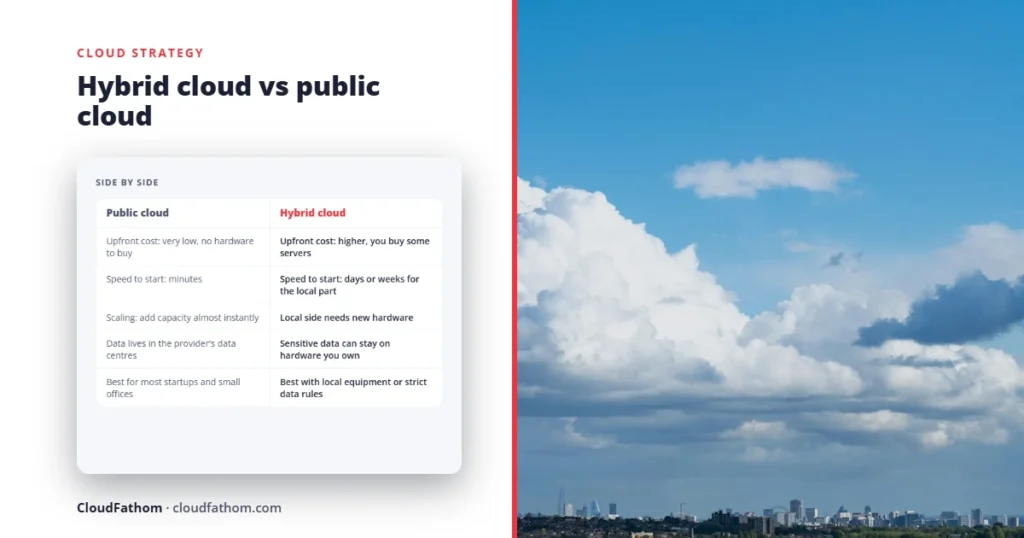
For a full step-by-step plan, see our 90-day cloud migration plan for small businesses. If you are deciding whether to keep part of your setup on your own hardware, our guide to hybrid cloud vs public cloud explains the options.
What the EU Data Act changes
If you operate in the EU, the Data Act makes leaving a cloud provider easier. Until 12 January 2027, any switching charges must not be more than the provider’s direct costs of the switch. From that date, switching charges, including data egress charges for the switch, are banned altogether. Two limits are worth knowing: the ban covers the one-off switching process, not your normal day-to-day data transfer, and providers can still charge cost-based egress fees when you run two clouds side by side.
Common mistakes to avoid
- Comparing server prices only. Data transfer, storage, backups, IP addresses and support plans often change the result.
- Moving everything at once. A big-bang migration is the riskiest way to switch. Move in stages.
- Rebuilding lock-in somewhere else. If you swap AWS-only services for another provider’s proprietary services, you have the same problem with a new logo.
- Forgetting security settings. Access rules, backups and logging do not move automatically. Our list of the top cloud security issues is a useful checklist for the new setup.
- Ignoring your team’s skills. A cheaper provider that nobody on the team knows can cost more in time and mistakes.
Frequently asked questions
What is the best alternative to AWS?
There is no single best one. Azure and Google Cloud are the closest full replacements. DigitalOcean, Akamai Cloud and Hetzner are better for simple, predictable hosting. Oracle Cloud and Cloudflare R2 stand out when data transfer costs are the main problem.
Who is AWS’s biggest competitor?
Microsoft Azure. Synergy Research Group put Microsoft at 20% of worldwide cloud infrastructure spending in Q2 2026, compared with 28% for AWS and 15% for Google.
Is Google Cloud cheaper than AWS?
Sometimes, but not by default. List prices for common services are in a similar range, and the result depends on discounts, regions and how your app uses data. Price your actual workload on both before deciding.
Which cloud has the lowest egress fees?
Among the providers in this guide, Cloudflare R2 and OVHcloud public cloud (in Europe and North America) charge no egress fees. Oracle includes 10 TB a month free, Hetzner includes 20 TB per EU server, and Akamai Cloud charges $0.005 per GB after its pooled allowance.
Is it expensive to move off AWS?
The data transfer part no longer has to be. AWS waives data transfer out charges for customers leaving, if you request it through AWS Support. The bigger cost is usually people’s time: planning, rebuilding, testing and training.
Is DigitalOcean a good AWS alternative for small businesses?
For websites, SaaS apps and client projects, often yes. It is easier to learn, includes transfer with every Droplet and has a predictable bill. For complex enterprise or compliance-heavy systems, a hyperscaler is usually a better fit. Our guide to cloud computing for small businesses covers how to choose.
Sources
- Synergy Research Group: Cloud market share trends (Q3 2025)
- Synergy Research Group: Q2 2026 cloud market release (30 July 2026)
- AWS News Blog: Free data transfer out to internet when moving out of AWS
- AWS: Summary of the Amazon DynamoDB service disruption in US-EAST-1 (October 2025)
- Amazon: AWS launches AWS European Sovereign Cloud (15 January 2026)
- Oracle: Cloud networking pricing
- DigitalOcean: Bandwidth billing
- Akamai Cloud (Linode): Network transfer usage and costs
- Hetzner: Cloud servers
- Cloudflare: R2 object storage
- European Commission: The Data Act